Weekly Reflections
Reimagine Education?
This week pushed me to think more carefully about what it actually means to “reimagine education.” It’s easy to agree with the idea in theory, but reimagining education is less about replacing everything we know and more about questioning what we prioritize. A big theme that came up in my head, especially while watching Most Likely to Succeed, was how often learning is shaped by assessment and efficiency rather than curiosity or meaning. What stood out to me was the tension between how students naturally learn outside of school, through collaboration, exploration, and online spaces, and how learning is often structured inside classrooms. Technology has made information easier to access than ever, but that doesn’t automatically mean learning is deeper or more engaging. Without thoughtful pedagogy, digital tools can simply reinforce traditional, teacher-directed models.
I also found myself thinking about how realistic large-scale change actually is. Even when teachers want to try new approaches, they are working within systems that reward grades, coverage, and consistency. That pressure doesn’t disappear just because we want learning to look different. For me, this suggests that reimagining education needs to be gradual and intentional rather than all-or-nothing.
Lesson Plans vs. Learning Plans
When comparing lesson plans and learning plans, I see value in both, especially in a Social Studies setting. Lesson plans offer structure and shared direction, which is important when students are building background knowledge or engaging with complex ideas. Clear planning helps create a common starting point and ensures key concepts are addressed.
Learning plans, on the other hand, shift some of the responsibility to students. In Social Studies, this could mean allowing students to choose topics, questions, or formats that connect to issues they care about. This kind of flexibility can make learning feel more relevant and meaningful. However, learning plans also require strong support systems. Some students may struggle with open-ended tasks, and without careful scaffolding, choice can become overwhelming rather than empowering.
There are also equity considerations. Learning plans often assume students have time, resources, and confidence to work independently, which isn’t always the case. Because of this, I don’t think learning plans should replace lesson plans. A blended approach allows for structure while still leaving room for student voice and inquiry.
Professional Learning Networks (PLNs)
One thing that became clearer to me this week is how much learning happens through conversation. This is where PLNs feel especially valuable. PLNs give educators a space to ask questions, share ideas, and learn from people working in different contexts. They can help normalize uncertainty and experimentation, which is important when trying new pedagogical approaches. At the same time, PLNs aren’t automatically inclusive. Certain voices can dominate, and there are real considerations around privacy and professional boundaries when engaging online. Even with those challenges, PLNs seem essential for meaningful change. They encourage reflection, expose blind spots, and remind us that education isn’t something we figure out alone.
Closing Reflection
Overall, this week helped me see that reimagining education is less about finding the “right” model and more about staying responsive to learners, to context, and to community. Balancing structure with flexibility, and innovation with care, feels more realistic than chasing a complete overhaul.
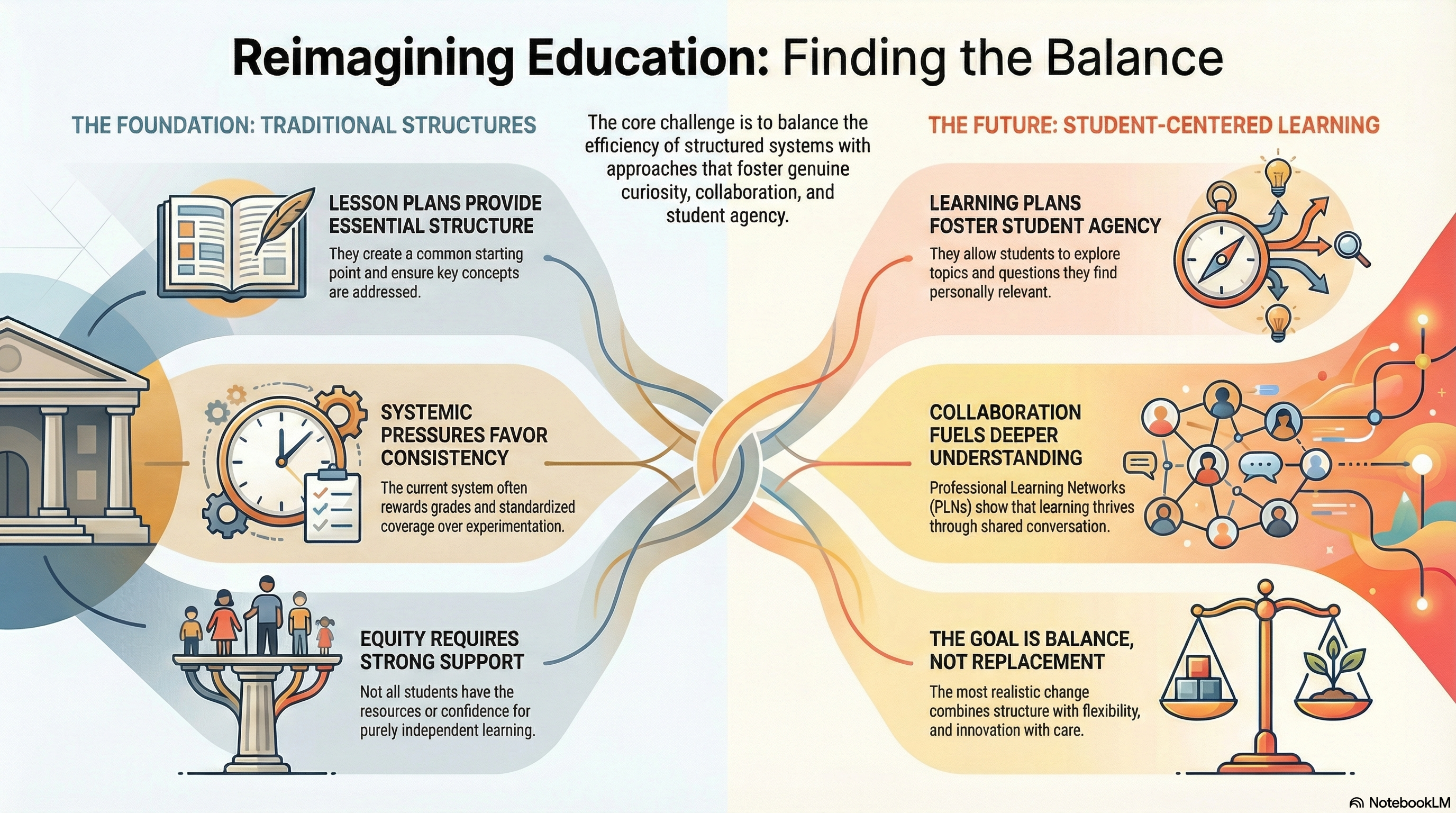
I’m curious how others are navigating this balance in their own learning or teaching contexts. Where do you feel tension, and where do you see possibility? I also had NotebookLM create this infographic below. I copied my text above into it and asked if it could make an infographic of the information, and it gave me this!
References:
McCue, R. Lesson Plan vs Learning Plan. https://soundcloud.com/rich-mccue/lesson-plan-vs-learning-plan?utm_source=clipboard&utm_campaign=wtshare&utm_medium=widget&utm_content=https%253A%252F%252Fsoundcloud.com%252Frich-mccue%252Flesson-plan-vs-learning-plan
Uvic Libraries. Video Libraries. Most Likely to Succeed. (2015).
Poth, R. D. (2023, July 28). Building your professional learning network. Edutopia. https://www.edutopia.org/article/professional-learning-networks-teachers/