Generative AI and the Limits of Automation
This week’s focus on generative AI pushed me to slow down and think beyond the excitement surrounding these tools. Much of the public conversation frames GenAI as a solution to educational problems, but what stood out to me most were its limitations. GenAI systems do not actually understand content in the way humans do; they generate responses based on patterns rather than meaning. This creates real concerns around accuracy, bias, and misinformation, particularly in subjects that require nuance, context, and ethical judgment.
Another major limitation is equity. Access to GenAI tools is uneven, and students’ ability to use them effectively often depends on prior knowledge, digital literacy, and support outside of school. There are also concerns around data privacy and surveillance, especially when students are asked to engage with platforms that collect and store user data. Without clear policies and guidance, GenAI risks reinforcing existing inequalities rather than reducing them.
GenAI in the Classroom
At the grade level I hope to teach in Social Studies, I see GenAI as a tool that could support learning, but only within clear boundaries. GenAI could be useful for brainstorming inquiry questions, generating multiple perspectives on an issue, or helping students rephrase ideas during the drafting process. Used this way, the tool acts as a starting point rather than a replacement for thinking.
However, I do not think GenAI is appropriate for tasks where the goal is to assess individual understanding or original analysis. In Social Studies especially, learning involves grappling with ambiguity, developing arguments, and situating ideas within historical and cultural contexts. If GenAI is used uncritically, it can flatten these complexities and encourage surface-level engagement rather than deep learning.
I found a nice short video explaining the usage of AI in the classroom for teachers: https://www.youtube.com/watch?v=umgBo0ncX4c
Personal Reflections on Using GenAI
In my own experience, I have found GenAI most useful as a support tool rather than a shortcut. It has helped me organize ideas, clarify my thinking, and reflect on how to structure written work. At the same time, I have noticed that relying too heavily on GenAI can distance me from the learning process. When answers come too easily, it becomes harder to sit with uncertainty or struggle productively with ideas.
From an educational perspective, this tension feels important. GenAI can save time and reduce barriers, but it can also reduce opportunities for critical thinking if not used intentionally. This reinforces the need for clear expectations and open conversations with students about when and how these tools are appropriate.
Closing Reflection
Overall, this week reinforced the idea that generative AI is neither inherently good nor inherently harmful in education. Its impact depends on how thoughtfully it is integrated into learning environments. Rather than asking whether we should allow or ban GenAI, a more productive question may be how we can use it to support learning without undermining the skills we value most.
I’m curious how others are navigating the use of GenAI in their own learning or teaching contexts. Where do you see its potential, and where do you think its limits need to be clearly drawn?
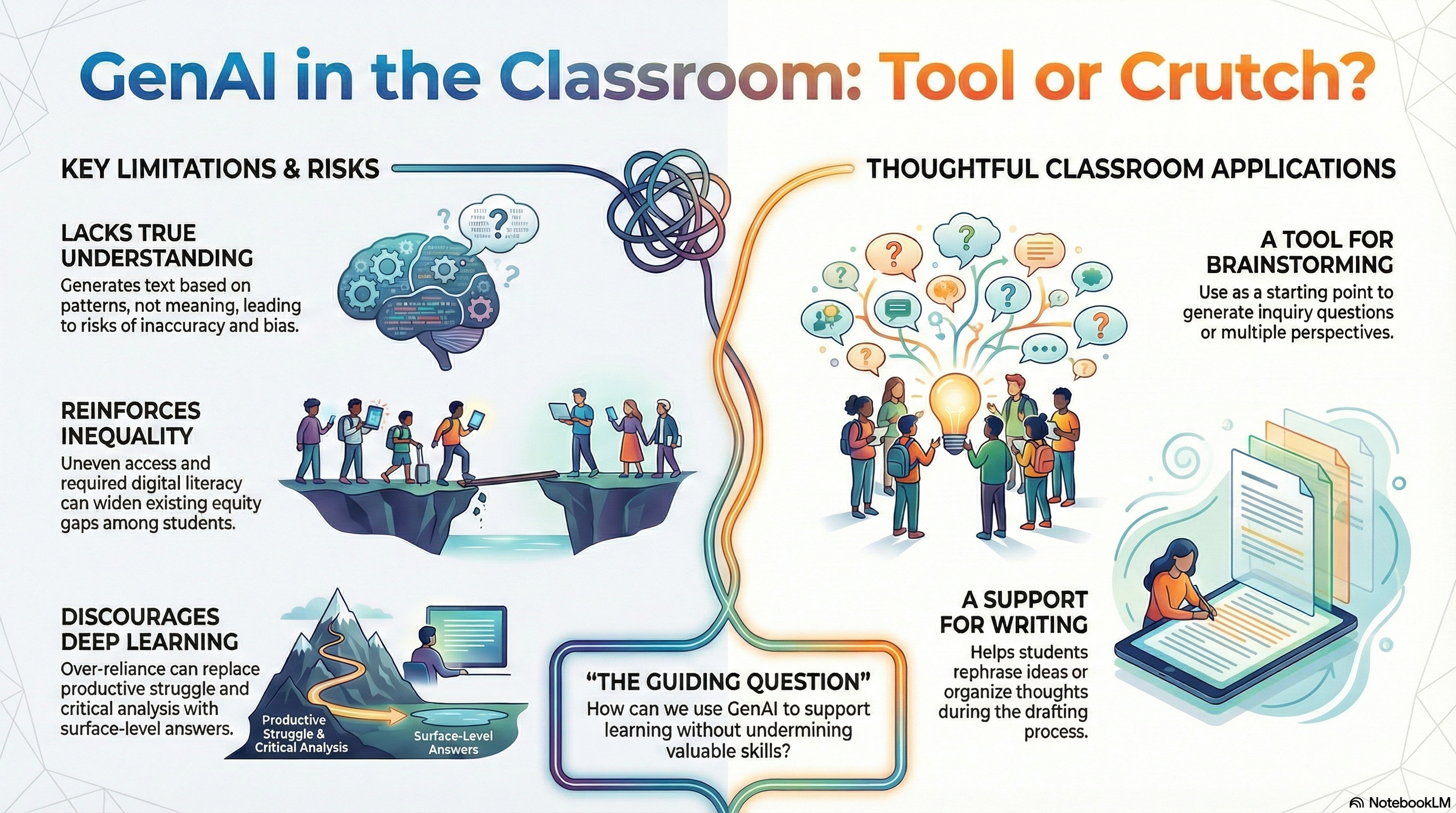
Here is an infographic I got NotebookLM to make using the prompt: “Can you make an infographic on the benefits and drawbacks of GenAI use in the classroom?”
Overall, I don’t see any errors in the text